

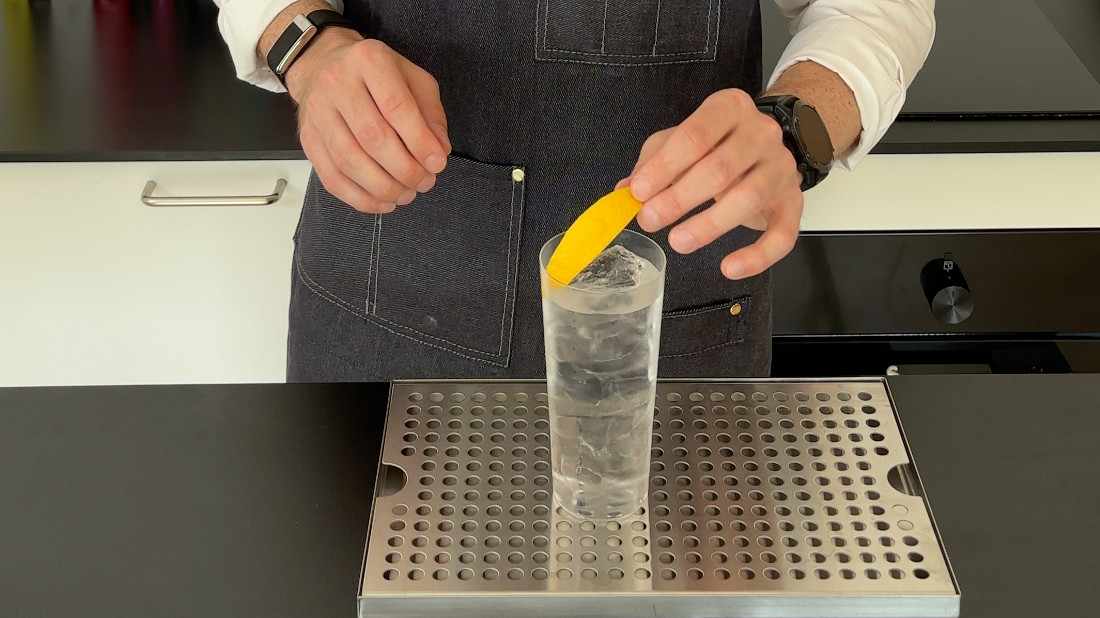
The most foundational technique for making drinks is the method of "building" a cocktail.
Similar to the "combined" method of prep, the whole process is simply adding ingredients together and making sure they are properly mixed.
A typical description of the build method looks something like this:
Add all your ingredients to a highball glass filled with ice. Then add your garnish on top and optionally serve with straw.
Because building a drink is so simple, it's a good opportunity to talk about the small details of how to handle glassware, ice and garnishing. For this, the most helpful approach is to look at a real recipe and describe each step in a high level of detail.
By reading the universal method recipe below, you will be able to transfer the detailed steps across to any other drink that's made using the "Build" method. Just swap the relevant ingredients, glassware, ice and garnish based on the specific recipe at hand.
The Peche Universal Recipe for building a drink is the classic Gin & Tonic which looks like this:
Gin & Tonic
Ingredients
- 50 ml Gin
- Top Tonic Water
Garnish
- Lemon Wedge
- Glass
- Highball
- Method
- Build
- Ice
- Cubed
The very detailed description of how to make this universal Gin & Tonic in a professional bar looks like this:
-
Grab a highball glass by the base and fill it all the way up with cubed ice.
When handling any glassware, whether building a drink or by other methods, it is considered best practice to always hold the glass as far from the top as possible.
Highballs and rocks glasses are to be handled by their very base while stemmed glasses, such as wine glasses, martini glasses or champagne flutes, are to be held by the bottom of the stem, just above the base.
The reasons for always handling glassware by the base are partly stylistic, as it looks far more elegant and avoids greasy fingerprints on the glass, and most importantly for optimal hygiene. If a guest is expected to put the glass to their lips, then it doesn't look good that a member of staff has just rubbed their fingers all over the rim of the glass.
-
Add your 50ml of Gin to the glass followed by the tonic water until the liquid reaches around 1-1.5cm from the top. (~0.5inches)
The level to which a glass is filled with liquid is also called the wash line. A key part of a professional bar is the consistency of the wash lines across all served drinks.
The glass should never be so full it spills over when moved, yet should never have the guest feel like the drink is served too short.
When building a drink, many recipes simply specify to "top" or "fill" with a mixer which makes this step possible to adjust on the fly.
For other method drinks that require preparation separate to the glass, such as shaking or stirring, it is important the recipe and glassware fit each other. If the wash line doesn't reach 1-1.5cm from the rim, then either the recipe or glassware should be changed.
In theory, this last rule about the recipe fitting the glass also applies to the simple spirit & mixer drinks like the gin & tonic. A general ratio for a delicious spirit & mixer is a 1:2 ratio, such as 50ml of gin with 100ml of tonic which can be easily achieved with the right size of glassware.
-
Add your straw to the glass and put the lemon wedge on top of the drink, resting over the straw. If the ice has moved during the pouring steps above, add one or two more cubes to finish the drink.
Getting the ice level right is arguably the hardest part of any drink served over cubed ice.
There are two general rules for ice in a drink. The ice should never float and no cube should be left dry.
What this means is easy to see once trying to make a drink with a glass that's only half full of ice. Due to the density of ice compared to water, the ice cubes will want to float near the surface. The simple solution to this is adding more cubes to weigh down the ones below until they reach all the way down to the bottom of the glass. Once the bottom most ice cube touches the bottom of the glass, we can say that no ice is floating.
For the rule that no cube should be dry, it's the opposite end of the same stack of cubes. We add cubes to weigh down the rest, but we don't want so many cubes in the glass that none are touching the liquid on top. If any ice cube is added and it sits above all liquid, then that qualifies as a "dry" cube and should be removed.
When the right level of ice is achieved, the last step of garnishing also becomes easier as the garnish can now safely rest on the ice without sinking into the drink.
Straws are mostly optional today apart from the cocktails served with crushed ice. If a straw is used in a drink, then the general rule of garnishing is that the garnish should be placed next to, or "over", the straw. The reason for this is simply that it brings the garnish closer to the guest's nose when drinking, which enhances the aromatics and overall experience of the drink.
This is the long and detailed description on how to build a cocktail in any professional bar. The method is simple in itself, but to perfectly execute a built drink, attention must be paid to the small details.
Given all these professional details, the method description is not useful to repeat on all recipes. This is why professionals use the shorthand "Build" when talking of drinks mixed in this way.
Whenever you see a drink saying it's to be built in the glass, this is the exact method to consider.
A Short Note on Mixing
In step 2 above, the gin is added before the tonic water. This is a minor detail but is actually a purposeful decision because the sugary tonic water is heavier than the alcohol so it makes them mix more evenly without added effort.
Sometimes, depending on the ingredients, a small lift of the ice can help with evenly mixing everything in the glass when building drinks. This is achieved by using a bar spoon to reach the bottom of the glass and slowly pick up the bottom ice cube for a couple of cm (about an inch) while lightly moving it up and down. This is not intended to fully stir the drink, but merely being a light mixing action before getting to step 3 of finishing the drink with perfect ice, wash line and garnish.
Building a Drink in Summary
The above method article covers everything you need to know in order to make a professional built drink, such as a gin & tonic.
The method & rules can be summarised in 5 professional steps:
- Always handle glassware by the base
- Ice should never float and never be dry. Always fill the glass completely with ice.
- The recipe used should fit the glass. A good spirit & mixer ratio is typically 1 part spirit to 2 parts mixer. Your glass should be the right size for that.
- The "wash line" defines how full the glass is. This should typically be within 1-1.5cm from the rim of the glass.
- Straws are optional in most drinks today and the garnish should always be placed next to or "over" the straw. Garnishing becomes significantly easier if the ice, wash line and glassware steps above are followed.
With this method description, you should now be able to perfectly execute a world class cocktail using the "build" method of making drinks.
For a video explaining this method of building in more detail, check out the Peche Hospitality Youtube video here: https://www.youtube.com/watch?v=AWorq-yj6aQ
Cheers!