

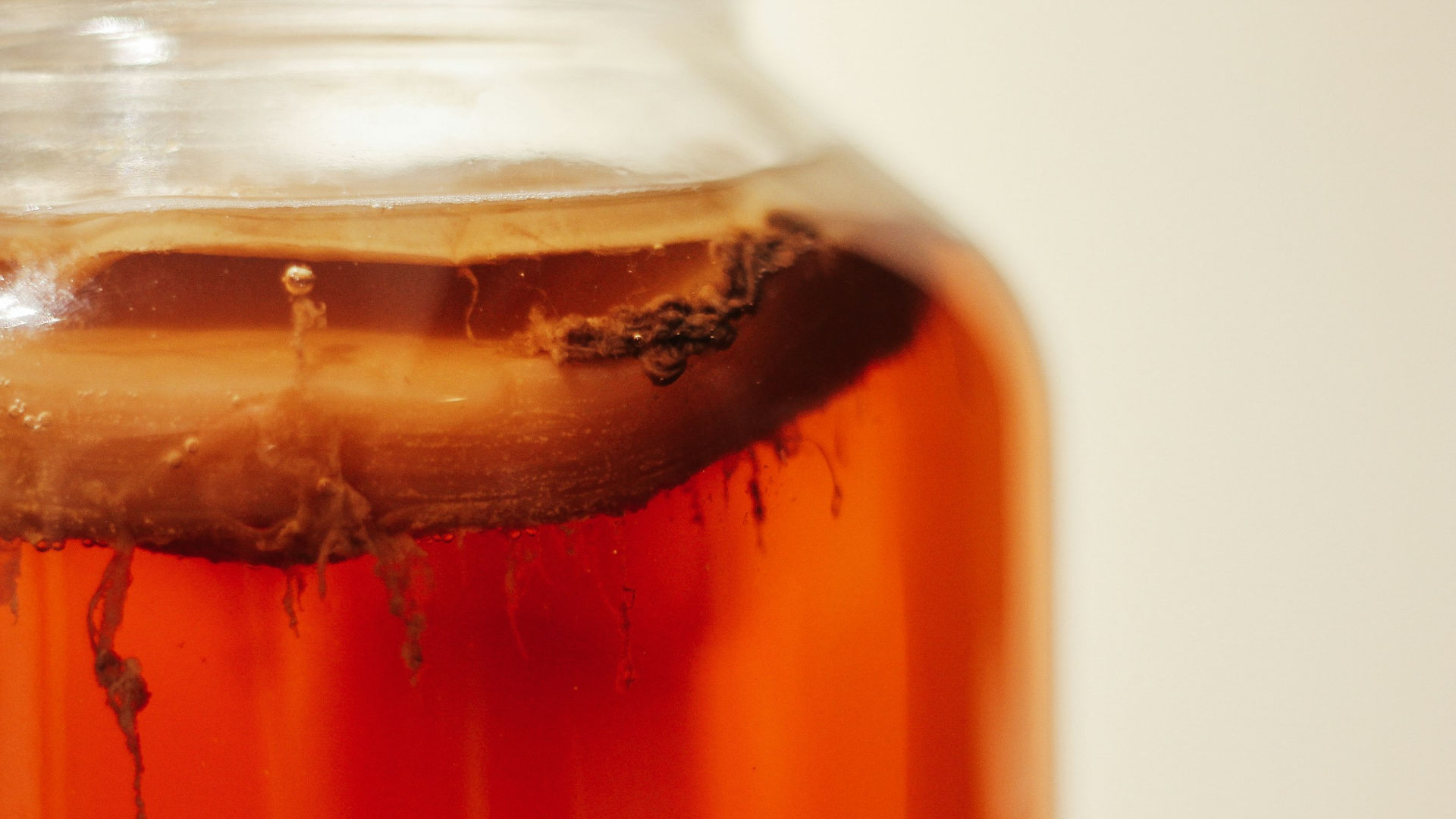
Kombucha is a fermented tea drink. Named the ‘tea of immortality’ with origins from 220B.C northeastern China. It most commonly goes through two fermentations. For the best results in kombucha fermentation you need a healthy SCOBY and some pre-fermented starter liquid.
Kombucha relies on a SCOBY (Symbiotic Culture of Bacteria and Yeast). It is a rubbery disc that rests on top of your sweetened tea/starter liquid like a lilypad. It is a cellulose structure built by bacteria and yeasts. The SCOBY protects against contamination and prevents evaporation, it also grows more with each successful brewed batch.The community of organisms also live within the fermented liquid and having a percentage of this already fermented liquid (starter liquid) in each new batch of kombucha is essential.
The nerdy science behind it
A SCOBY is a zoogleal mat (mass of bacteria and yeast tied together with cellulose nanofibres). The bacteria and the yeast rely on each other, they work together in perfect harmony. The mat also protects the fermenting tea from any wild bacteria and yeast while homing the wanted bacteria and yeast.
Kombucha is unique because it consists of three different types of fermentation; alcoholic, lactic and acetic but also under two different conditions; anaerobic (without oxygen) and aerobic (with oxygen).
Once all the ingredients are combined, the first process that happens is the yeast starts to break down sucrose from the tea brew. As the yeast does this, it produces carbon dioxide and ethanol through fermentation. At the same time, the bacteria use sugars and the ethanol, with oxygen available at the surface, to produce organic acids and more of the bacterial cellulose (lilypad), constructing more layers. The bacteria also transform the ethanol into organic acids, lowering the pH and creating that unique tangy kombucha taste. The lower pH also helps protect the brew from unwanted bacteria. The second stage is bottling this brew, trapping carbon dioxide to increase carbonation. This is also a key part for introducing desired flavours through adding fruits, purees and herbs.
The base
The base of every kombucha starts with sweetened tea. ‘Tea’ means the traditional Camellia Sinensis; black tea, green tea, white tea, oolong (not tea infusions such as camomile and mint). Tea infusions can be used but it is recommended around 50% Camellia Sinensis for the fermentation to work and keep your SCOBY healthy long-term. Using a 1% loose leaf tea to water ratio is a good starting point.
Brewing a strong tea; less water more tea means you can dilute/cut it with cool water, then you can add the SCOBY straight away and not have to wait for the tea to cool down. If you add the SCOBY to hot tea it will kill the live bacteria and yeast and cook the SCOBY ruining the culture permanently. Here are some brewing times recommended by Hannah Crum & Alex LaGory from ‘The Big Book of Kombucha’
| Variety | Brewing Temperature | Steeping Time (Minutes) |
|---|---|---|
| Assam (Black) | 93 ℃ | 4-6 |
| Darjeeling (Black) | 93℃ | 3-5 |
| Silver Needle (White) | 82℃ | 3-5 |
| Sencha (Green) | 77℃ | 3-4 |
| Oolong | 88℃ | 5-8 |
| Hibiscus (Blend, Tisane) | 100℃ | 4-6 |
Sweetening the base
Most kombucha brewers work between 5-7% raw sugar to tea ratio. So if I'm brewing 3.8L (1 us gallon) I would use 200g(1 cup) of sugar. Studies show that during fermentation that sugar reduces by 50-70% between 7-14 days. The best sugar for the job is raw sugar, often called evaporated cane juice. It is processed enough for the organisms to consume it easily and still has useful vitamins and minerals. Plain white sugar can also be used, but look for the words ‘cane sugar’. Other sugars that can be used such as pasteurized honey and maple syrup, these will produce different flavour profiles.
First Fermentation and testing that its done.
Cover the tea and SCOBY with a breathable material so it still has an air supply but nothing can get inside. The larger the batch the longer the brewing time will be, 2-3L or less will be typically 4-7 days, over 3-6L 7-21 days. You may need to brew two seperate batches at the beginning to see how your kombucha thrives in your enviroment.
No two SCOBYS/ kombucha fermentations will ever be the same and we can never perfectly control a brew. The best way to monitor kombucha is an age tested and proven method of tasting. By day 6/7 of the fermentation look for a balance where the sweetness has faded and you have a slightly acidic sour tang. Tasting along the way will help you.
If you want to go further then just tasting, pH testing strips/meter will help. Testing brews alongside taste to know that at 7 days in your usual brewing conditions you have a pH of 3.2 and that tastes better than 10 days fermentation with a pH of 2.8 can create consistency in your brewing. Your rough starting pH will be at around 4.5.
For commercial kombucha production very sophisticated lab testing must be employed, because organic acids, high degrees of sediment and bacteria continuing to produce acids from ethanol can throw off simple pH strips and hydrometers.
Second Fermentation and adding flavour.
Second fermentation is optional, your kombucha is ready to drink already.
However second fermentation is the bottling stage where you can add fruit, juice, or sugar to brewed kombucha and seal it in pressure-safe bottles producing a fizzy drink. The second fermentation needs sugar to begin and leads us to the perfect moment to introduce different flavours. If you don’t want to add anymore flavours but still want to make it carbonated simply add 1 teaspoon of sugar to the pressure-safe bottle, fill with your kombucha leaving 2 inch head space, seal and leave outside the fridge for 2-3 days.
If you want to introduce flavours you can add 10-15% of the volume of the bottle in fruit juice or fruit puree, the natural sugars inside of the fruits will start the fermentation. This is the chance to get creative with flavours. Frozen fruit work well as the sugar cell wall has been broken from the freezing process, this makes the sugar easily accessible for the yeast. Any fruit, juice, puree will work or even a syrup you have made beforehand.
Your kombucha can be left alone no need to burp it, that will only draw the process out longer. After 2-3 days you can refrigerate the kombucha and it's ready to enjoy. It is normal in this second fermentation for a small SCOBY to grow, you can strain this out when you pour out of the bottle.
Where to brew
Glass jars are the most common for kombucha brewing but you can also brew in wood barrels, high quality stainless steel, porcelain and ceramic and food-grade plastics. For the second fermentation to produce more bubbles, beer bottles with rubber pressure cappers work the best. Your kombucha should be kept out of direct sunlight and preferably slightly warmer conditions. A kitchen counter, on top of the fridge or in a safe nook somewhere. Out of the way of cigarette smoke, pollen, cooking fumes and other ferments. Covering the glass jar is essential, but with something breathable; cotton fabric, cheesecloth, muslin cloth or coffee filter. Secure it with a rubber band.
Healthy SCOBY and storage!
DO NOT BELIEVE the myth that storing your SCOBY in the fridge is healthy. Actually putting your SCOBY in lower temperatures for long periods of time will put the acetic-acid to sleep more permanently. This means that they cannot protect the brew and will often lead to mold growing in your first couple of ferments. You can temporarily put the SCOBY through cold conditions for 1 or 2 days. But longer than that may have very bad side effects.
If you’re not fermenting or have extra SCOBY you want to keep healthy you can put it in a 'SCOBY hotel'. Using a glass mason jar, fill it with your extra SCOBYS, along with your normal sweetened tea and starter liquid 5:1 ratio. Leave this OUTSIDE the fridge and every couple of weeks feed it a bit more of sweetened tea/more mature kombucha as it will evaporate over time.
It will grow a thick SCOBY layer on top if left, so every couple of weeks you can move that layer a little so the oxygen supply isn't completely cut off to the liquid. The hotel will survive well by itself with little to no maintenance. You can use the liquid from your hotel as your starter liquid in your kombucha brewing.
A healthy scoby will be smooth on top, firm but jelly like. It will grow multiple layers and can be teared or cut up and used for more fermentation. Kombucha can and will have dark yeast strains growing underneath them, this isn’t unhealthy or moldy. Mold can be dried fuzzy spots, green/blue or opaque in colour. If your kombucha is growing mold, throw away the entire batch and sanitize properly before starting again. NEVER use contaminated SCOBYs.
Black Tea Kombucha Recipe
Ingredients
- 20g loose leaf black tea
- 100g cane sugar
- 200mls starter liquid
- 2l water
- SCOBY
- fruit or sugar for second carbonation
Make a sweet black tea
- Boil 1L water, remove from heat, add 20 grams of loose leaf black tea, let steep for 10 minutes.
- Strain out tea leaves and add 100g of sugar, stirring till dissolved
Make the kombucha batch
- add 1L cool water
- with clean hands add the SCOBY. Pour 200mls of starter liquid on top of the SCOBY.
- Cover the jar with a breathable cloth and secure with a rubber band
First fermentation
- Allow to ferment for 4-7 days, taste along the way.
- Once at a desire taste it is ready to refrigerate and drink, take 1 cups worth for the next kombucha batch from the top of the brew. After that remove the SCOBY, placing in a SCOBY hotel or in the next batch.
Second fermentation and a bubbly brew
- Bottle your brew from the first fermentation and add 1 teaspoon sugar or your fruit flavouring to the bottle, leaving only 1-2cm headspace.
- leave for 1-4 days at room temperature.
- move them to the fridge and enjoy!
Inspiration for advanced recipes
Cutting the black tea with
- camomile
- white tea
- rose petal tea
- dried hibiscus
- dandelion root tea
Replacing the sugar with
- freshly cut up pineapple
- pomegranate juice
- blueberries (cut in halve or squished)
- chopped up dates
- apple juice
- rhubarb sauce
- chai spice and honey
Kombucha can be drunk by itself or added to cocktails, the possibilities are endless.
Once you start to make kombucha and feel confident it becomes a gateway for all different types of flavours and exploration.
There are a lot of good books out there on kombucha with hundreds of different recipes. My personal favourite is making an elderflower kombucha and making a whisky soda with it. Enjoy!