

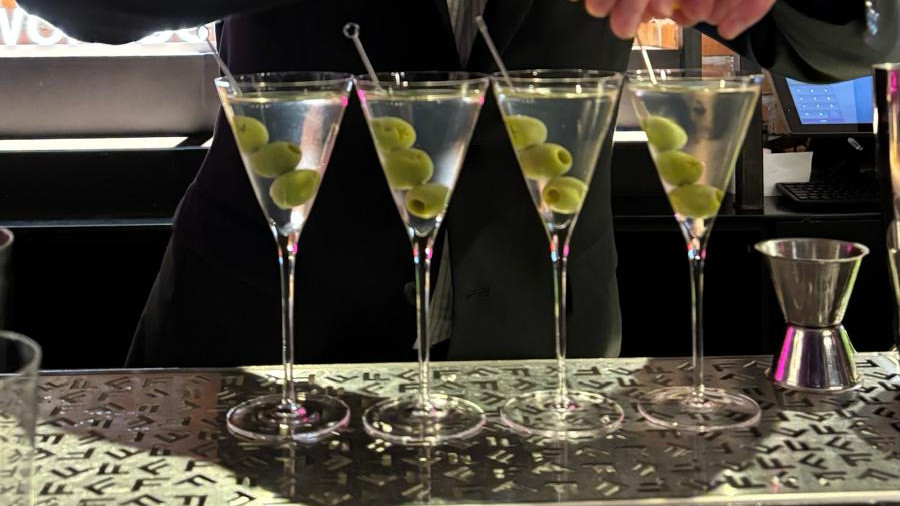
The Dry Martini is one of the most famous core classics in the history of mixed drinks. It's true origins are elusive, yet it has been labelled a core "parent" in the concept of cocktail families ever since David Embury summarised "Six Basic Cocktails" in his 1948 book, "The Fine Art of Mixing Drinks".1
Although the exact creation origins are unknown, there are a few things we know for sure:
- The Martinez, despite being considered a twist on the Martini, is actually a precursor.
- The Manhattan cocktail is likely the true parent of this style of cocktail.
- The concept of a Wet Martini is an entirely made up construct that doesn't exist in history...
The first two points are more or less agreed upon among cocktail historians. The Martinez was first put in writing by O.H Byron in 1884 and defined "Same as Manhattan, only you substitute gin for whisky"2 while the Manhattan itself was likely created in the 1860s at Manhattan Inn by George Black.3 The Martinez we recognise today was defined in mid 1880s recipe books (likely first in 1887) as bitters, maraschino, old tom gin and vermouth.4
The third point is a whole different bag that I'm about to open and explore now.
First, let me start by saying this doesn't actually change anything about how you might make a Dry Martini or even a so called Wet Martini. Neither am I arguing it's a drink to be deleted from history nor am I saying we should stop making Martinis "Wet" (I personally prefer a more balanced Martini and I think the ultra dry "just a dash" of vermouth concoction need to get in the bin). I am instead saying that we should simply stop calling it wet. Not just for historical reasons, but out of respect for the next generation of bartenders. My personal opinion doesn't count as truth though, so let's instead go back in time...
The Origins of (Formally) Mixed Drinks
A natural place to start is with a (very) short history of the Martini and the "Cocktail" as mixed drinks. On Tuesday 13th of May, 1806, the New York paper "The Balance and Columbian Repository" first defined the cocktail with these words: "Cock-tail, then, is a stimulating liquor, composed of spirits of any kind, sugar, water, and bitters - it is vulgarly called bittered sling".
What's commonly known today as an "Old Fashioned" is therefore the base template for a cocktail (by original definition) and is simply booze and bitter balanced with sugar and dilution. This is the base definition upon which we begin the story of how a Wet Martini doesn't exist.5
Throughout the 1800s, the art of mixing drinks spread rapidly while recipe books for spirited drinks started taking hold. The book "Oxford Night Caps" in 1827 documented various punches, bishops and cups while the legendary Jerry Thomas' "Bartender's Guide or How to Mix Drinks" in 1862 expanded with more "Cocktail" style drinks.6
Although Jerry Thomas did not include direct recipes for the Martini, Martinez or Manhattan, he did get fancy and include what seems to be the natural stepping stone from the Cocktail style to the Martini style of drink.
Before diving into this stepping stone, let's take a step back and look at what a Martini actually is.
A Martini is simply Gin, Vermouth and, depending on who you ask, bitters. Even if we take the bitters out of the equation, the Vermouth is itself an aromatized wine made with bitter ingredients, such as wormwood, and sugar to balance the flavour experience. This means in technical terms, if Vermouth is a compound of bitters and sugar, then the (at least original) Martini was simply a cocktail composed of spirit, sugar, water and bitters but fancily served straight up. This may be an upsetting conclusion to cocktail purists so let's elaborate.
"Improved" by being "Fancy"
Jerry Thomas (and other pre 1900 bartenders) made a lot of Brandy Cocktails, Whiskey Cocktails (now the Old Fashioned) and even Gin Cocktails. His 1862 "Gin Cocktail" was gum syrup, bitters, gin and curacao with a lemon peel garnish.7 (As a side note, Hugo Ensslin christened this Gin Old Fashioned drink as "Night Cap")8.
Historically, most cocktails at some point received the prefixes "Improved" or "Fancy" which denoted a special effort to go beyond just the basic template or a simple dash of curacao. "Improved" typically meant a base cocktail with some form of flavouring added such as maraschino or chartreuse while "Fancy" was the same thing but served up in a "Fancy Wine Glass".
What's interesting in the context of the Martini is the "Fancy Gin Cocktail" which Thomas defines "...same as the gin cocktail, except that it is strained in a fancy wine-glass and a piece of lemon thrown on top...".9
We now have a stirred drink, served straight up with a lemon twist containing gin, bitter, sugar and a bit of orange flavour. If you're in the camp of people who demand a dash of bitters in the Martini, then you'll know the old school Martini recipes (and the Racquet Club / Marguerite / Astoria / Mahoney / Hoffman House) used orange bitters to round the flavours of the gin and vermouths.10
With this concept of "Improved" and "Fancy" utilising maraschino or curacao we're brought one step closer to the Martinez (and Martini), but we haven't yet found Vermouth for the mix...
The Vermouth Cocktail
Vermouth entered the cocktail books at the end of the 1860s via "The Steward & Barkeepers Manual"11. This book is interesting, not because of it's inclusion of a "Vermuth Cocktail" (this version was just vermouth, a single ice cube and a lemon twist), but because it's the first book serving gin, bitters and wormwood straight up with a lemon twist.
There are two versions of a "Gin Cocktail" in this manual which shows the variations being served at the time. The first version is the traditional cocktail formula of gin, sugar, bitters and a dash of curacao served on the rocks while the second version is gin, sugar, bitters and absinthe served straight up with a lemon twist. With absinthe's primary flavouring being wormwood we are starting to see a move towards bittering agents other than just Angostura and the famous Boker's. The combination of flavours in these two drinks are basically identical to O.H Byron's first Martinez printed 15 years later in 1884. Gin, curacao, bitters and sweet wormwood in the form of Italian Vermouth (or absinthe here).
Martinis and the Journey to Dry
Fast forward 20 years to the late 1880s and we now have both the Martinez and Martini popping up all over the place. The first written recipes for the Martini appears in 1888 when Harry Johnson and Theodore Proulx both referred to it as "Martini Cocktail" with the latter explicitly stating it's "...made like any other cocktail...".12 This seems to back up the claim made above that a Martini (from a component perspective) is simply a "Fancy Cocktail" as it contains the same combination of spirit, water and the taste balance of bitter and sweet.
Martini Cocktail (1888)
Ingredients
- 3 drop Orange Bitters
- 5 ml Gum Syrup
- 5 ml Orange Curacao
- 35 ml Gin
- 35 ml Sweet Vermouth
Garnish
- Lemon Twist
- Glass
- Martini
- Method
- Stirred
- Ice
- No Ice
Fast forward another 20 years to the early 1900s and we've started seeing a "Dry Martini" appear in multiple works of fiction13 as well as being explicitly defined as such in cocktail books.14
The question to ask here is simple. What does it mean for a Martini to be Dry? (And why is a "Wet" Martini not the opposite?)
To answer this question we'll go to William "Cocktail Bill" Boothby and his first publication of 1891 where he prefixed his Martini recipe with the instructions "This popular appetizer is made without sweetening of any description, as the Old Tom Cordial gin and the Italian vermouth of which it is composed are both sweet enough."15
This is the first instance of the Martini Cocktail being made without the explicit addition of sweetener other than what's in the existing ingredients. Just like a white wine can be described as too sweet if the residual sugar levels are too high, Bill Boothby declared the mixture of the Martini Cocktail as sweet enough without added sweetening. Throughout history, great inventions happen after some magical spark or ignition point occurs within the relevant industry. The 1890s was the ignition point for moving away from sweetness and towards a drier cocktail experience. The journey to drier drinks had officially begun which leads us to the first potential creation point of a Dry Martini as we recognise it today.
Introducing a Dry Cocktail
Today, the terms Dry, Extra Dry (and Wet...) are used casually in relation to the Martini. Throughout the 20th century, it almost became cool to swear off any sweetness and go drier and drier until eventually an Extra Dry (or Naked) Martini was made by stirring a glass of Gin next to an open bottle of vermouth. The definitions of "Dry" and "Extra Dry" has always been common terminology in wine and champagne production (where the opposite of dry is sweet) but the cocktail world didn't start using these until 1895 when George Kappeler published his "Modern American Drinks".
This is the book that first defines a cocktail in its regular form, as dry and finally as extra dry. Kappeler includes his regular Manhattan recipe, a "Manhattan Dry" and a "Manhattan Extra Dry".16
The Manhattan he includes is what we today know as a Sweet Manhattan but with "two dashes gum syrup" which he serves with a lemon twist or a cherry.
The dry version he defines simply as "...leaving out syrup and cherry" while the extra dry version is "Leave out syrup and cherry, and use French vermouth in place of Italian".
This shows that the movement towards dry is actually more of a move away from sweet.
Although George Kappeler hasn't explicitly defined a "Dry Martini", this book is also the very first mention of a recipe that's widely recognised today as the true classic.
Any seasoned bartender will immediately recognise the Racquet Club Cocktail as a classic Dry Martini:
Three dashes orange bitters, half a jigger Tom gin, half a jigger French vermouth, in a mixing glass half-full fine ice. Mix, strain into cocktail glass, add piece twisted lemon-peel.
It was to be another decade before the Martini cocktail was formally defined as Dry in recipe books. In 1904 Applegreen's bar book included a "Martini Cocktail, Dry" although this still used Italian styled vermouth and was simply the "omit the syrup" kinda thing. In the same year Frank Newman published his "American Bar" book in Paris which can be credited as the first officially published recipe for a "Dry Martini Cocktail" including bitters, gin and dry vermouth and a guest choice of garnish between cherry, lemon twist or olive.17
Dry Martini (1904)
Ingredients
- 3 drop Orange Bitters
- 35 ml Gin
- 35 ml Dry Vermouth
Garnish
- Lemon Twist
- Glass
- Martini
- Method
- Stirred
- Ice
- No Ice
Why the Wet Martini Isn't Real (And why it matters!)
Although the original Dry Martinis mentioned above were often a 50/50 split of gin and dry vermouth, the 1900s saw a wild overcorrection away from sweetness by almost, and sometimes completely, removing vermouth from the mix. This laid way to wild variations such as the Churchill or Naked Martini18 and naturally someone had to fix this by going back to larger quantities of Vermouth for a more balanced drink. I agree with David Embury when he said "It is hard to say which is worse, the half-and-half dishwater or the swish-and-return dynamite. Both fall short of what a Martini should be."19
While the original move towards dry was a move away from sweet, this new reverse movement away from dry became known as wet. Although a natural linguistic assumption, that wet is the opposite of dry, this is a misnomer and I think that's important to recognise.
It's not important for purity reasons nor is it a call for keeping Martinis bone dry. It is instead an appreciation of the logic behind how drinks, from a flavour perspective, are made to be balanced in the context of teaching the next generation.
Imagine if we had done the same with sour style drinks. Imagine for a second if original recipes were a simple 50/50 balance of sugar and citrus but we then made an overcorrection over many decades away from sweetness and started referring to drinks as "Sour Daiquiri", "Sour Margarita" or "Sour Sidecar" because the recipes were now 5-to-1 on the citrus-to-sugar part.20
When realising this new norm is unbalanced, we naturally move back away from sour but in the process mistake the opposite of sour as cheerful or happy.
While the idea of a "Happy Margarita" does sound delicious, it's deeply pointless from a conceptual taste perspective. It makes no sense to the original balancing of the drink, it makes no sense in describing the drink and it especially makes no sense from a learning or understanding cocktails perspective.
The sweet/sour balance of flavours are naturally easier to balance due to earlier exposure to sour tastes in life. The concept of sweet vs dry is not. The dryness of wines and spirits, or what's more technically called astringency, is something that for most people requires active learning. If we introduce new bartenders to the concept of cocktail families as being governed by "Sours" and "Martinis", then it's straight up criminal to start talking about Martinis as being wet. Martinis were always wet! It's a liquid and it has nothing to do with the ratio of vermouth in the drink. In fact, original mentions of Martinis being wet were purely humorous and jokey21 while the first recipes were either Tequila Martinis or for purely calorie counting reasons.22
If we can correctly assert that the opposite of a Dry Manhattan is the Sweet Manhattan, then transitioning back23 to calling the opposite of a Dry Martini a Sweet Martini (Or just Martini...) should be a simple step. Dry isn't balanced with wet, it's balanced with sweet. There's a reason most junior bartenders can better balance a Manhattan than a Martini when winging it and I'm fairly certain it's because no one ever asked for a Wet Manhattan.
Dry Martini
Ingredients
- 20 ml Dry Vermouth
- 60 ml Gin
Garnish
- Discard Lemon Twist
- Glass
- Martini
- Method
- Stirred
- Ice
- No Ice
A video showing the first 1888 Martini Cocktail alongside the first 1904 Dry Martini and a modern Dry Martini has been made by Peche and is available on the channel here: https://youtu.be/8wWSJAYvdhs
References
-
1948 - Embury, David A. - The Fine Art of Mixing Drinks
On page 99 of his now famous book, David Embury begins his chapter "Six Basic Cocktails" covering the Martini, Manhattan, Old Fashioned, Daiquiri, Side Car and Jack Rose.
In line with the above article, he begins this chapter with recipes 1, 2 and 3 being Dry Martini, Medium Martini and Sweet Martini.
-
1884 - Byron, O. H. - The Modern Bartender's Guide
On page 21 he introduced the Martinez Cocktail as being "Same as Manhattan, only you substitute gin for whisky".
EUVS has made this book available online via this link
-
1923 - Mulhall, William F. - Valentines Manual of Old New York
The Valentines manual was an annual collection of writings and statistics by various writers and council officials of New York City at the time. In the 1923 edition, William Mulhall, who used to work at Hoffman House, wrote a chapter called "The Golden Age of Booze" in which he credits a man named Black as the creator of the Manhattan cocktail when he wrote "The Manhattan cocktail was invented by a man named Black, who kept a place ten doors below Houston Street on Broadway in the sixties - probably the most famous mixed drink in the world in it's time. The cocktail made America famous and there were many varieties of of them - in fact, the variety was infinite..." Cocktail historian David Wondrich later researched this claim further and found proof that a man named George Black did indeed run a bar near enough to the location described by William Mulhall.
-
1887 - Thomas, Jerry - Bartenders Guide or How to Mix All Kinds of Plain and Fancy Drinks
On page 25, Jerry Thomas includes his Martinez Cocktail Recipe including bitters, maraschino, old tom gin and vermouth.
EUVS has made this book available online via this link
-
1806 - The Balance and Columbian Repository
This newspaper reference to the word cocktail is widely recognised as the first written definition.
-
1827 - R. Cook - Oxford Night Caps and 1862 - Thomas, Jerry - The Bartenders' Guide
These two books are widely recognised as the first explicitly drinks making publications where Jerry Thomas' Bartender's guide is considered the first real cocktail book.
Both are available via EUVS online for free: Oxford Night Caps and The Bartenders' Guide
-
1862 - Thomas, Jerry - The Bartenders' Guide
On page 51, Thomas defines his Gin Cocktail recipe as gum syrup, Bogart's bitters, gin and curacao.
EUVS has made this book available online via this link
-
1917 - Ensslin, Hugo R. - Recipes for Mixed Drinks
On page 62, Ensslin has a Night Cap recipe served in an Old Fashioned glass that's simply, sugar, bitters and gin with a single cube of ice.
EUVS has made this book available online via this link
-
1862 - Thomas, Jerry - The Bartenders' Guide
On page 51, Thomas also includes his Fancy Gin Cocktail recipe and writes that it's simply a "...gin cocktail, except that it is strained in a fancy wine-glass and a piece of lemon peel thrown on top..."
EUVS has made this book available online via this link
-
1895 - Kappeler, George J. - Modern American Drinks, 1898 - Unknown - Cocktails How to Make Them, 1905 - Mahoney, Charles - Hoffman House Bartender's Guide and 1914 - Straub, Jacques - Drinks
All of these books include famous "original" variations of the Dry Martini starting with the Racquet Club in 1895 followed closely by the Marguerite, Mahoney (Later references as Hoffman House Cocktail) and the famous Astoria cocktail.
All are made available online by EUVS
-
1869 - Unknown - Haney's Trade Manuals: The Steward & Barkeepers Manual
This is the first book to assert a "Cocktail should never be shaken" and also includes the first reference to gin, bitters, sugar and curacao being mixed with wormwood (absinthe) in the Gin Cocktail recipe on page 32.
EUVS has made this book available online via this link
-
1888 - Johnson Harry - New and Improved Bartender's Manual and 1888 - Proulx, Theodore - Bartenders' Manual
These are the first mentions of "Martini Cocktail" recipes found in bartender manuals.
Both are available on online via EUVS.
-
1897 - Le Queux, William - Whoso Findeth a Wife and 1900 - Bell, Lillian - The Expatriates
As far as I can ascertain, the 1897 book by William Le Queux is the first ever written mention explicitly mentioning a "Dry Martini" in the chapter "Cosmopolitan" when Le Queux writes "...and glancing across to the bar, shouted, "Mix another dry Martini, Tommy, for my friend.". See gutenberg project for full book
The 1900 novel by Lillian Bell also references a Dry Martini on page 78 and explicitly declares it should include an olive as such "Dry Martini cocktail, father, with an olive in it". See the Internet archive for page reference
-
1904 - Newman, Frank - American Bar and 1904 - Applegreen, John - Applegreen's Bar Book
These are the first two books mentioning a Martini explicitly as dry. The French book by Newman is the first one including a Dry Martini recipe using the gin, dry vermouth and orange bitter version we recognise today.
Both are available on online via EUVS.
-
1891 - Boothby, William T. - American Bartender
This is the book that explicitly outlines that the sweet perception of Old Tom style gin combined with the sweeter Italian style vermouths are enough to balance without further measures of sugar. His classic Martini recipe mentioning this is cocktail no 27 on his list.
EUVS has made this book available online via this link
-
1895 - Kappeler, George J. - Modern American Drinks
The first book to reference what "Dry" and "Extra Dry" means in the context of cocktails as he included both versions of a Manhattan Cocktail recipe on page 38.
EUVS has made this book available online via this link
-
1904 - Newman, Frank - American Bar and 1904 - Applegreen, John - Applegreen's Bar Book
These are the first two recipe books mentioning a Martini explicitly as dry. The French book by Newman is the first one including a Dry Martini recipe using the gin, dry vermouth and orange bitter version we recognise today.
Both are available online via EUVS with Newman's version found on page 27 here
-
Both a Naked Martini and Churchill Martini recipe are made without any vermouth in the actual drink meaning it's literally a glass of ice cold gin either straight from the freezer or stirred down with a bit of dilution.
-
1948 - Embury, David A. - The Fine Art of Mixing Drinks
On page 100, at the beginning of the "Six Basic Cocktails" chapter, Embury expresses a few personal opinions about the making of Martinis. He also follows up on page 104 with his idea of what defines dry, medium and sweet Martinis.
-
For the purposes of this example, let's imagine you make a 50ml / 20ml / 20ml Daiquiri (or 2oz / 0.75oz / 0.75oz) against a pretend "Sour Daiquiri" of 50ml / 20ml / 5ml (or 2oz / 0.75oz / 0.125oz). The point here is that the "Sour" version is as unbalanced, in principle, as an Extra Dry Martini with a single dash of vermouth and correcting it by re-balancing it requires sweetness, not "wetness" or "happiness". Incidentally, drinking a 50/20/5 Daiquiri probably brings as much happiness to a guest as a 60/5 Dry Martini...
-
Pulitzer Prize winning journalist, Hal Boyle, mentioned a Wet Martini multiple times in his columns of the 1950s. In 1952, both the Independent Journal and The Salem, Ohio, News brought his piece titled "Have an Opinion on Something? - Just Keep It To Yourself" where Boyle wrote "Some bartenders are now enforcing a new rule: 'positively no dry Martinis served to customers talking politics. If you insist on doing so, you'll have to take a wet martini'. As nobody in the history of Martini-drinking ever knowingly drank a wet one. This iron threat has kept peace at the bar, or at least a truce..."
In 1953, George Taubeneck wrote a poem in the "Air Conditioning & Refrigeration News" mentioning a Wet Martini: Eavesdropped for years, but never yet. Have I heard the order: Martini Wet.
The light-hearted "Webster's Unafraid Dictionary" of 1967 defined a Wet Martini as "A cocktail for people who hate gin and love vermouth".
-
Interestingly, there are incredibly few mentions of a "Wet Martini" in actual publications once we go beyond the scope of the wider internet and blogs (even today!). The first written recipe for a "Wet Martini" might be credited to Barbara Gibbons, in her news column "The Slim Gourmet" in the Pottstown Mercury on September 7th of 1972 as an attempt to make happy hour "less potent in calories". She later released a cookbook in 1976 titled "The Slim Cookbook" in which she repeats the recipe on page 378 alongside other low calorie options titled "Slim Gimlet", "Lower Manhattan", "Left-Handed Screwdriver", "Demi Daiquiri" and many more. Her Wet Martini recipe was "1 ounce gin or vodka and 2 ounces dry vermouth. Shake with ice and strain into a cocktail glass with an olive. Only 125 calories". The first Wet Martini recipe found in an actual drinks book was also in 1976 in the Tequila Book by Marion Gorman where it's also called Martini Mojado and described as "Prepare exactly the way you make your favorite dry martini, except use tequila instead of gin".
-
I'm saying "transitioning back" here because Martinis have always been referred to as Sweet, Medium or Dry in historical books. This is true for many authors such as David Embury in the 1940s, Stanley Clisby Arthur in the 1930s and Harry McElhone, Robert Vermiere or Joe Fitchett of the 1920s.