

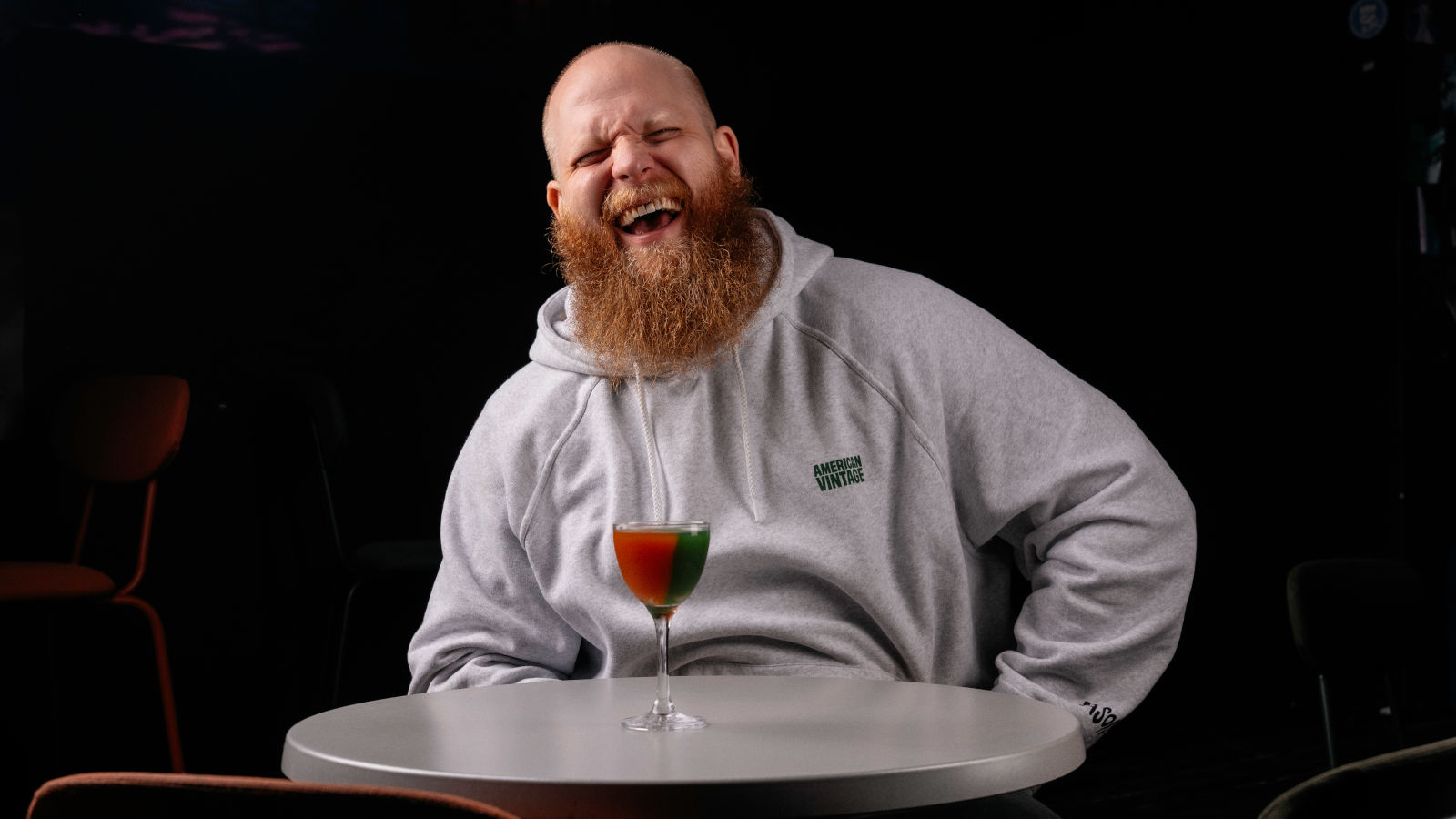
An Inspirational Possibili-tea
As with all modern ideas, innovation requires inspiration.
Being a true professional in the field, Henri knows the history of food & drinks techniques very well. He knew the idea of combining hot & cold had been attempted before, but in a very different setting to a bar.
Back in the early 2000s, chef Heston Blumenthal alongside Chris Young and their team at The Fat Duck restaurant in England made waves with their signature Hot & Iced Tea serve.
A few years prior, Heston had dined at the legendary El Bulli restaurant where they served a layered hot & cold pea soup. As he returned to England, his colleague Chris Young was busy experimenting with fluid gels in dishes and drinks, and after putting their heads together, they came up with a brilliant insight!
Unlike drinks (or soups) that layer hot and cold liquids on top of each other, The Fat Duck wanted to serve the two temperatures side by side, in the same glass!
The secret to this incredible visual and experiential effect is what's known as fluid gels. Very, VERY light fluid gels.
To understand fluid gels, consider the super annoying ketchup glass bottles. You turn it around and everything stays inside, but as soon as you tap it, EVERYTHING comes pouring out at the same time. That's very similar to how fluid gels behave. When not in motion, they act more like semi-solid gels that refuse to move and mix. Once movement begins, they change behaviour and act like drinkable liquids.
Blumenthal, Young and the team at Fat Duck used a combination of gellan gum, sodium citrate and calcium chloride to create this effect.
By adding less than 0.1% of the gum to each tea mixture, the team would heat the mix to activate and hydrate the gum and then slowly cool it over an ice bath before passing it through a fine sieve and refrigerating before service.
The method itself is a clean and now well known way to handle fluid gels, but there's only one problem with transferring this to bartending. Alcohol complicates everything...
Gellan can work with alcohol, but ethanol changes how its gel network forms and behaves. What works beautifully in tea can become a frustrating exercise in inconsistent texture, cloudiness or unwanted gel formation when adapted to a cocktail.
So do we just give up and say this only works with traditional British tea? Of course not!
The Creative Zoom
The creative process has one key step that's important to understand when coming up with new and innovative methods. It's a concept I like to call the Creative Zoom.
To explain this, let's look at a classic Daiquiri for a second:
Daiquiri
Ingredients
- 20 ml Lime Juice
- 20 ml Simple Syrup (1:1)
- 50 ml Rum
Garnish
- No Garnish
- Glass
- Coupette
- Method
- Shake & Strain
- Ice
- No Ice
It's a classic mix of rum, lime and sugar. Many bartenders today would recognise this as something called a "Sour", which changes the definitions slightly to spirit, citrus and sugar.
Many of us intuitively have quite a wide understanding of sugars. We can use white caster sugar, darker demerara sugar or we can get fancy and use "raw" unrefined jaggery sugar. With the lime juice being changed to the wider category of citrus, we can also play around with the similar lemon juice or even get creative with orange and grapefruit. So far so good.
Now, the first step of moving from the very specific "rum, lime juice & sugar syrup" to the less specific "spirit, citrus & sugar" is the first step in our creative zoom.
What we have conceptually done here is to zoom out a bit and add category labels instead of the specific product labels defined in the traditional spec. By using broader categories instead of specific labels, we also open the door to consider alternatives for the rum, such as Gin or Whiskey which would give us the drinks known as a fresh Gimlet or the classic Whiskey Sour.
But we can take this a step further and instead conceptually zoom in. By zooming in we flip the question from broad categories to specific functional purpose.
If we zoom in on the original spec of rum, lime and sugar, we can ask ourselves what each ingredient actually brings from the perspective of basic tastes (sweet, sour, salt, bitter, umami) and mouthfeels (hot, cold, dry/astringent, burning/biting, etc.).
If we instead zoom in and ask these questions we might describe the drink even more broadly as alcohol, sour and sweet.
With this new understanding, we can get creative BEYOND basic sugars, basic citrus and basic spirits. We can then start rebuilding those functions by using other sweet ingredients like liqueurs, other sour components like vinegars and other alcoholic ingredients like vermouths, beer or cider.
The most recognised example of this would be to swap the sugar syrup for triple sec and the rum for tequila. With a sweet orange liqueur now stepping in to support the lime and tequila, we have a classic Margarita. Optionally, it still has sugar syrup for balance, but that's ok as that still fits under our new and wider definition of alcohol, sour and sweet.
Margarita
Ingredients
- 5 ml Simple Syrup (1:1)
- 20 ml Lime Juice
- 20 ml Triple Sec
- 50 ml Tequila
Garnish
- Salt Rim
- Glass
- Coupette
- Method
- Shake & Strain
- Ice
- No Ice
By creatively zooming in or out, we can re-define existing templates. By re-defining existing templates, we can start re-building them into something genuinely new.
The Impossible Insight
Now, how do we go about creating a hot & cold cocktail serve when the foundational recipe fundamentally doesn't like alcohol?
Henri didn't accept defeat and instead creatively zoomed out to try and categorise what was happening behind the labels saying gellan gum, sodium citrate and calcium chloride.
At it's fundamental level, the purpose of these is to act as gelling agents and stabilisers. The gellan gum forms a network in the liquid which holds it together, in a similar way as how agar or gelatin works, while the sodium citrate and calcium chloride works to help the network form and remain stable.
With this slightly wider definition of "gelling agent and stabiliser", Henri could look for alternative ingredients with similar behaviour that would work much better with alcohol.
Through initial trial & error testing, and through tweaking national finals and European finals, Henri found the perfect ingredients for stable alcoholic hot & cold serves.
The answer was something called Gracila Gel and Gelcrem Hot, both produce by Sosa.
Gracila Gel is essentially powdered red seaweed from the same family that we get agar from. The crucial detail here is that it therefore works just fine with both alcoholic and acidic ingredients!
Gelcrem Hot is little more than cornstarch. Although it's not exactly the same as the stuff you'd get in supermarkets, it's a slightly processed version that helps stabilise the gel and add light texture.
The Final Moment
If you think of this like the Daiquiri to Margarita comparison, then it might seem straight forward work from here.
But if you've ever worked with agar or gelatin, you'll know there's a fine balance between something semi-liquid and something that's more like a full-on gel dessert. And that's before we even consider the serving temperature question!
To make a final drink that's thick enough to stay separated but thin enough to drink like a cocktail, Henri has created what's an exceptionally elegant spec that's now available to the wider industry for using as a template:
Hot/Cold Tea Liquid Gel
Prep ingredients
- 100 g Ron Zacapa Solera Gran Reserva
- 200 g The Moment Tea Cordial
- 2 g Gracila gel
- 2 g Gelcrem Hot
- 2 g Green Food Colouring
Yield
300 ml
Instructions
Make two versions using the same method: one with peach tea cordial, one with mint tea. The peach tea uses orange colouring while the mint tea uses green. Combine Zacapa with tea cordial in bowl over ice. Add Gracila and Gelcrem Hot and mix to dissolve while still cold. Heat…
The foundation is a clean 200g of cordial, to 2g each of gracila and gelcrem hot with food colouring added in just for visual clarity of division.
The cordial itself should be prepped in advance and then the technical step of the gels followed in detail. The most difficult thing here is to move quickly to ensure the gelling behaves as expected by continuously mixing as it chills to create the smallest possible gelling particles.
Once the two gels are prepped and set to temperature, the pouring is done with an initial divider in the glass that's then slowly removed before serving.
The Moment Tea Cordial
Prep ingredients
- 34 g Mint Tea
- 700 g Sugar
- 50 g Citric Acid
- 2000 g Water
Yield
2000 ml
Instructions
Brew tea according to packet instructions and adjust water volume to match spec. Then combine with sugar and citric. This is a template suitable for any tea and is intended for “The Moment” hot/cold serve.
The colours of the gels are used as a visual cue for where to drink for the best experience and the stemmed glass ensures the effect isn't broken by feeling the different glass temperatures before.
Henri will be serving this drink to the judges at the global finals of World Class 2026 next week in Scotland. Peche wishes him the best of luck.
You can find his original video announcement and teaser presentation of the drink here: https://www.instagram.com/p/Ddlw0bzIM5N/
Cheers! 🍸